
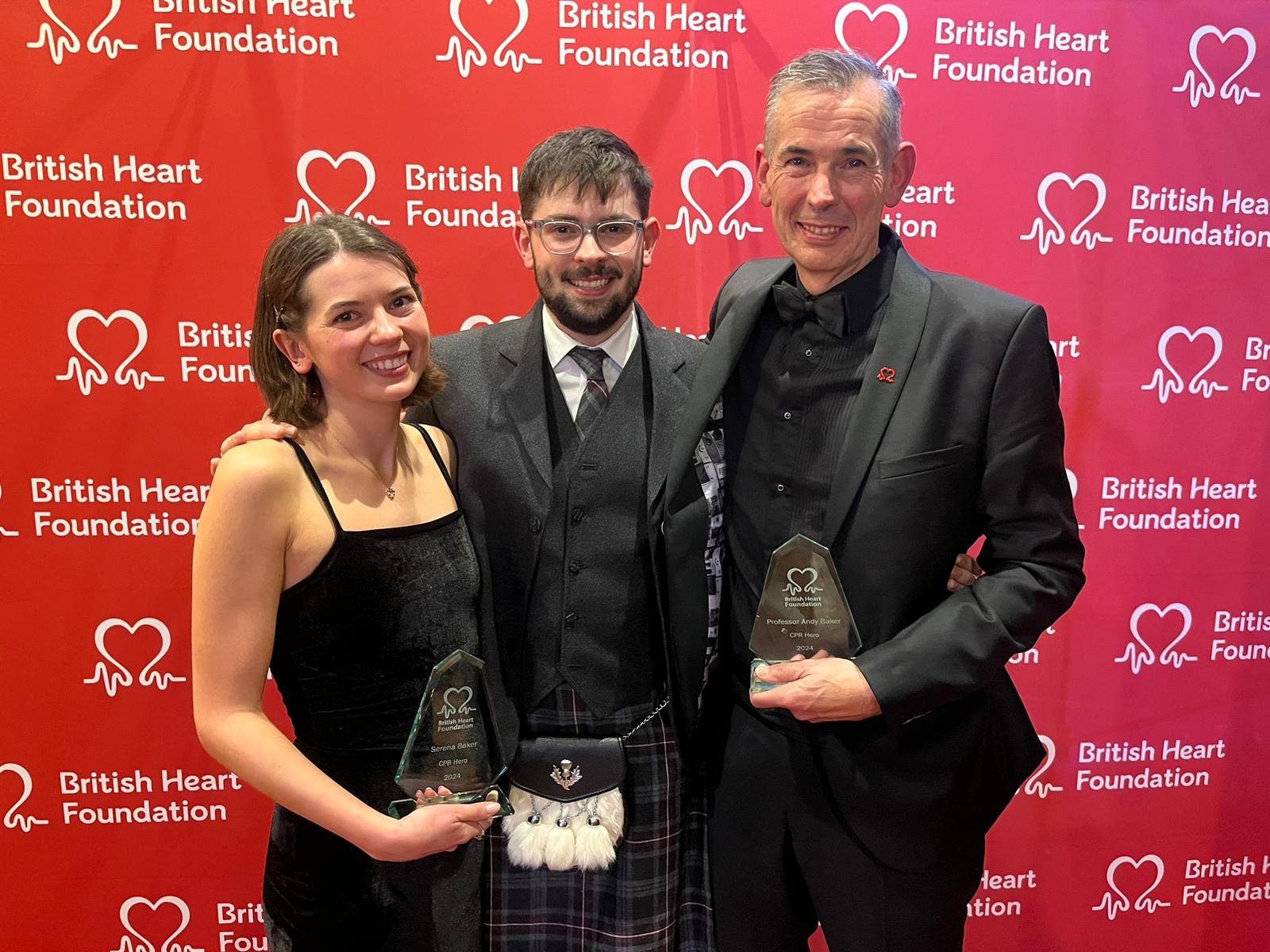
Summer 2022
As told by his father, Andrew H Baker
We were on a family holiday in the South of France in the summer of 2022. It was a terrific time. George and I had gone for a swim in the communal pool. The pool, which was about 40m in length wasn’t very busy at all – there was probably 20 people in there. Serena was sunbathing by the side of the pool. George and I were in the pool having a little bit of a fun competition as to who could swim the furthest underwater without coming up for a breath – so many people do that. We managed two attempts, going about 25 metres each time. Then I got out of the pool and left George in there because he said he wanted to attempt the full length of the pool, which was the original goal. He had another go, achieved 25 meters or so again, then I asked him “Why don’t you come out?” but he wanted to stay in the pool for one final attempt. He went back to the end of the pool and was sitting in the water for a couple of minutes, doing a little bit of hyperventilation thinking that would allow him to go further. He then began to swim underwater. He went a little bit further than 25 metres this time, perhaps to 30m. I was keeping an eye on him from the side of the pool. His bright orange shorts were helpful for this.
I was watching him closely and Serena was listening to music with her eyes closed. As George passed me at the side while swimming underwater, it looked like he then came up for air. I saw the back of his head come to the surface, then he went back under and I thought at that point that he simply wanted to complete the distance to the end of the pool. In retrospect, I realise he hadn’t actually come up far enough to breathe any air. When he submerged again, he then suddenly seemed to slow under the water. At this point I immediately stood up and started to realise something was wrong as he became static underwater. I became increasingly anxious, so I ran down the side of the pool and very quickly entered the water. When I reached George, he appeared lifeless at the bottom of the pool, eyes open facing upwards.
I don’t remember how I managed it, but I got him out of the pool and onto the side in one move. Thankfully it was quite shallow (about 1.2 metres) and it was an infinity-like pool so the adrenaline must have allowed me to get him out quickly, and I immediately started chest compressions. Possibly surprisingly for many people, given that I research cardiovascular disease, I had never been formally trained in CPR and I’m embarrassed to admit that. It was something I had always thought about learning, for example playing football as a child and hearing about the instances of sudden cardiac death in young players. But it was always a job for another day, and I don’t think I every truly believed I’d need to know CPR.
As I was doing chest compressions, my daughter Serena had thankfully sensed something was wrong and she ran over to where George and I were at the end of the pool on the wooden decking. On the way she shouted for someone to call emergency services. Serena, now a qualified doctor, was a 5th year medical student at the time, and was truly immense. She checked George’s airway whilst I continued chest compressions, and then Serena also performed chest compressions. I can’t remember the exact timings, George did not show an immediate response, perhaps another minute passed. I think he’d had about three minutes without oxygen in total and the world was quickly collapsing.
Suddenly, some water started to dribble from his mouth, and he started breathing slowly. He then started to make some horrific noises that will stay with me forever, I then thought he had serious brain damage at this time. However, things started to improve quite quickly and within about the next 2 minutes for the first time I thought George might actually be ok. He was very agitated, and Serena lay with him to keep him calm. A bystander who happened to be a nurse helped keep him calm and put him in the recovery position.
A German doctor then came to help from nearby and checked him over. Unfortunately, there was no defibrillator on site, but at this point George had a pulse. The ambulance crew arrived about 10 minutes later and his vital signs were fine. At this point, George was alert and coherent. A lady came over to us and said we had saved his life.
George was taken to the Nimes hospital where he spent 4 days undergoing numerous tests to identify an underlying cause for his cardiac arrest. They found no abnormalities and he was fitted with a loop recorder to monitor his heart. The battery in the device lasts for 3 years so if he has another event there will be a recording of his heart rhythm and rate at the time.
It is now very likely that George suffered underwater hypoxic blackout. This is a very rare but often fatal event where divers and pools swimmers can blackout before they return to the surface, due to hypoxia and a lengthened time for the body to activate the urgency for a breath due to altered blood gas kinetics. This has been known about for some time, but the awareness of it and the associated need for safety and knowledge is quite lacking.
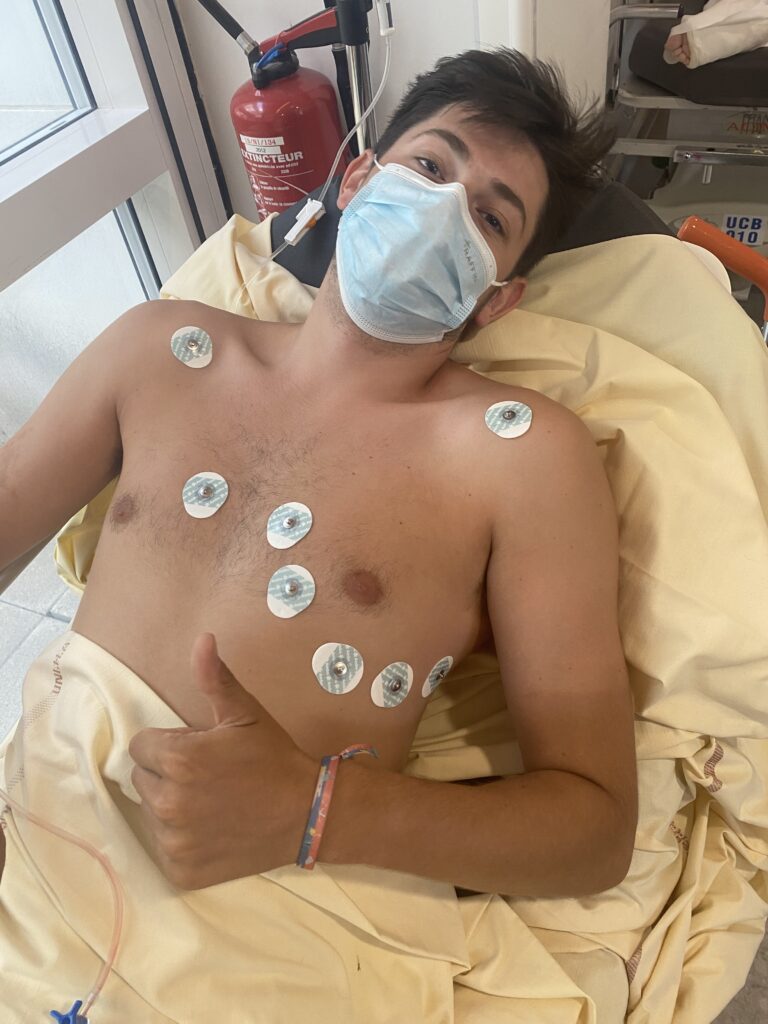
I’d like to extend my sincerest thanks to the bystanders and paramedics that treated George on site, the emergency room and the Cardiology ward in Nimes Hospital for their professionalism and care of George. On return home to Scotland, he saw a cardiologist who requested some genetic testing that thankfully came back negative. Rachel Myles, Adrian Brady and colleagues gave him such excellent care and attention. In the end, no underlying cause has been identified. It was just a terrible accident, likely due to a combination of hyperventilation and prolonged hypoxia.
The biggest lesson for me was how crucial it is to be trained in CPR. Serena had been trained as a medical student. I constantly think about what could have happened if Serena was not there. I remind myself that had I not kept a close eye on George and got him out the pool so quickly, the consequences could have been unimaginable Although Serena said she felt anything but calm, she acted with efficiency and impact. Serena and I made a great team.
I cannot imagine life without George and not a day goes by without me thinking about what nearly happened.
This has made me realise the absolute importance of everybody learning CPR and raising awareness of underwater hypoxic blackout. I am now passionate about encouraging everyone to get CPR training and improving safety in the water and knowledge of the dangers of hypoxia. It is very quick and easy to learn, and you never know when you might need to use it to help a loved one or stranger.
But it is also crucial that all public places have defibrillators on site. CPR training will teach you how to use them and the ambulance services are always available at the end of the phone during times of need.
This event has truly shaped my life. I want to thank those close to me who helped me come to terms with what we went through. As a family, we went to the edge of the abyss but were lucky enough to be pulled back. So many people are not lucky like us. Learning CPR is so important yet so easy, so please don’t be like me; learn CPR to one day have the opportunity to save a loved one, friend or stranger. We simply do not know what is around the corner.
My thanks go to:
- George, for being a fantastic son.
- Serena; no words can ever capture your brilliance on the day. Our tri-partite bond as a result of this day will stay with us until we die.
- Judith, my wife, for being the incredible support that you are, and for your everlasting love.
- The many people close to me that helped me through the aftermath of those days
- Professor Nick Mills for being a huge support on the end of the phone. Thank you for helping me make sense of what I did not understand on the day this happened. And Professor Martin Denvir, a colleague and great friend for his constant help and guidance.
- The paramedics, Nimes Emergency and Cardiology teams for their expert assessment and management of George.
- To all those offering help and encouragement in subsequent endeavours to improve knowledge and management of underwater hypoxic blackout and CPR training.
Thank you all.
Andrew H Baker.
Leave a Reply